
Criminal Cases in Taylor County Courts
Taylor County belongs to Florida's Third Judicial Circuit. Circuit Court hears felony prosecutions, while Taylor County Court handles misdemeanors, criminal traffic, and county ordinance matters. Both trial levels operate through the Taylor County Courthouse in Perry. The clerk, not the prosecutor or jail, is custodian of the judicial file. The Taylor Clerk criminal services page describes the local criminal divisions.
A charge label helps route the request. A CF suffix usually points to a Circuit felony file. MM commonly identifies a county misdemeanor, and CT marks criminal traffic. The year and sequence complete the number. Do not build a full case number from a fragment. Give the clerk the fragment, full name, and approximate filing date so staff can find the right index entry.
The clerk's criminal-services source shows how Taylor County court cases are divided for local service.
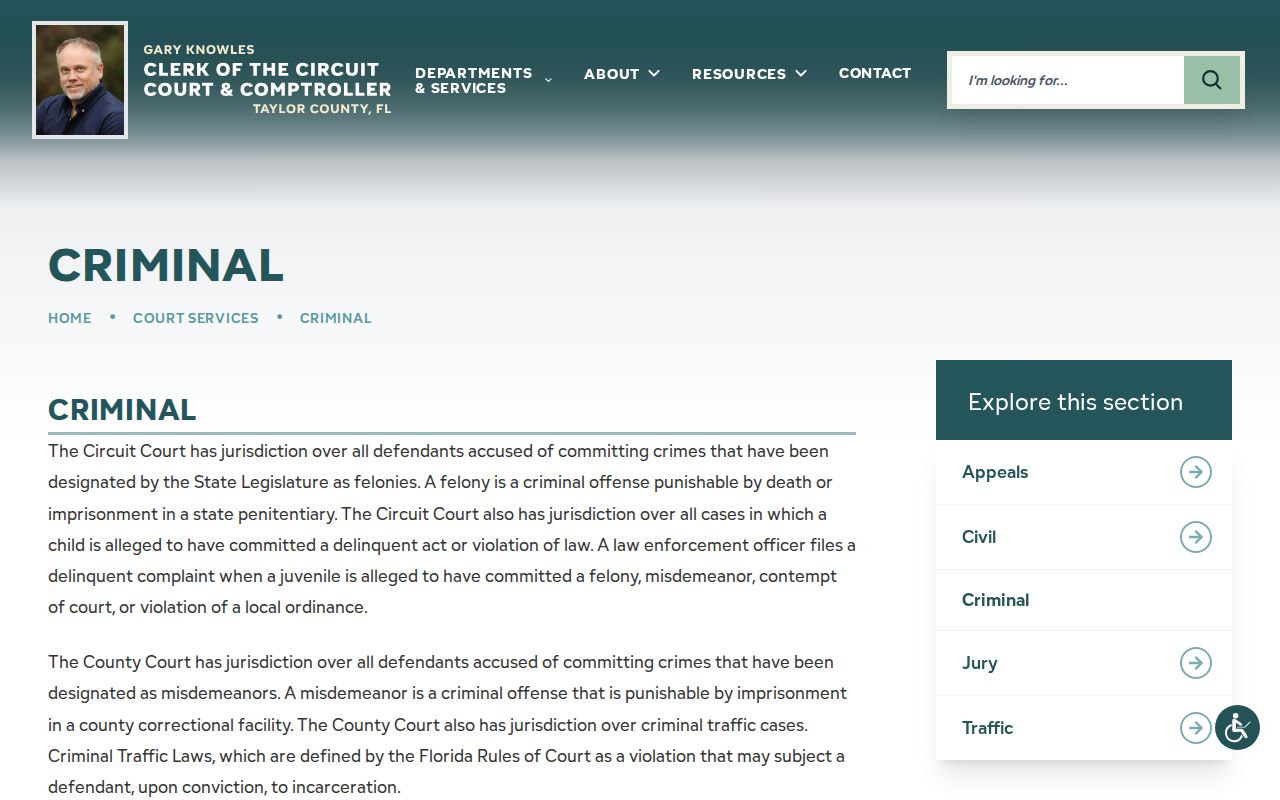
That division choice is the first practical filter before requesting a docket or disposition.
Taylor County Criminal Courts Compared
Three court layers can appear in one matter, but each stores a different record. The Taylor trial file begins in Circuit or County Court. The First District Court of Appeal reviews qualifying decisions from those courts. A federal prosecution arising in Taylor County belongs to the U.S. District Court for the Northern District of Florida, not the county clerk.
| Court or office | Role | Record route |
|---|---|---|
| Third Judicial Circuit, Taylor County | Felony trial cases and qualifying postconviction matters | Taylor Clerk criminal division |
| Taylor County Court | Misdemeanors, criminal traffic, and county ordinances | Taylor Clerk criminal division |
| First District Court of Appeal | Qualifying appeals from local trial courts | Florida ACIS |
| Northern District of Florida | Federal criminal prosecutions | PACER and the federal clerk |
The Third Judicial Circuit directory confirms the Taylor County offices and officials.
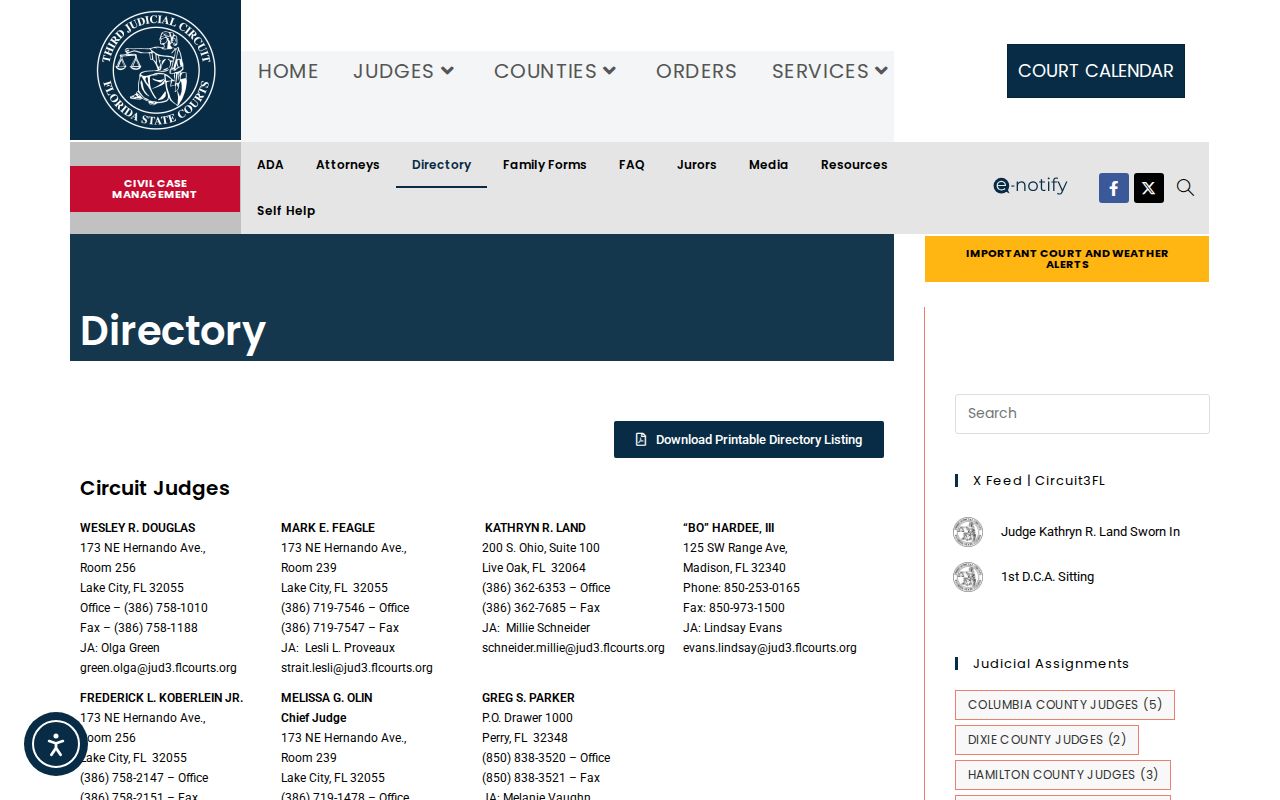
The directory helps confirm the court before a reader sends a file request to the wrong clerk.
How to Search Case Records
No clear public party-name trial docket was exposed on the current Taylor Clerk site during research. The reliable fallback is direct clerk service. Call 850-838-3506 or visit the criminal counter at 108 North Jefferson Street, Perry, Florida 32347. The clerk can route Circuit Criminal, County Criminal, and criminal-traffic requests. Ask for a register of actions or case index first, then choose the actual pleadings or orders needed.
- Decide whether the likely file is felony, misdemeanor, or criminal traffic.
- Gather the full name, spelling variants, approximate filing or arrest date, and known case number.
- Contact the Taylor Clerk criminal division and ask staff to identify the matching case.
- Request the docket, filed charge, disposition, judgment, or sentence by name.
- Ask whether delivery is electronic, by mail, or counter-only and whether certification is needed.
| Request field | Best use | Required | Notes |
|---|---|---|---|
| Full party name | Name index | Practically yes | Include spelling variants or an alias when known |
| Case number | Exact match | No | Most precise key; retain CF, MM, or CT |
| Filing or arrest year | Narrow results | No | An approximate year can separate similar names |
| Case type | Route division | No | Felony, misdemeanor, or criminal traffic |
| Document needed | Set request scope | No | Docket, information, judgment, sentence, or certified disposition |
When Taylor County Case Search Stops
A blank web result does not prove that no Taylor County criminal case exists. The name may be misspelled, the arrest may still be awaiting formal filing, or the matter may be juvenile, confidential, sealed, or expunged. The case may also belong to another county, a federal court, or a state agency. Start by checking the court level and date rather than moving to an unofficial people-search site.
The Taylor Clerk contact page provides the official courthouse route.
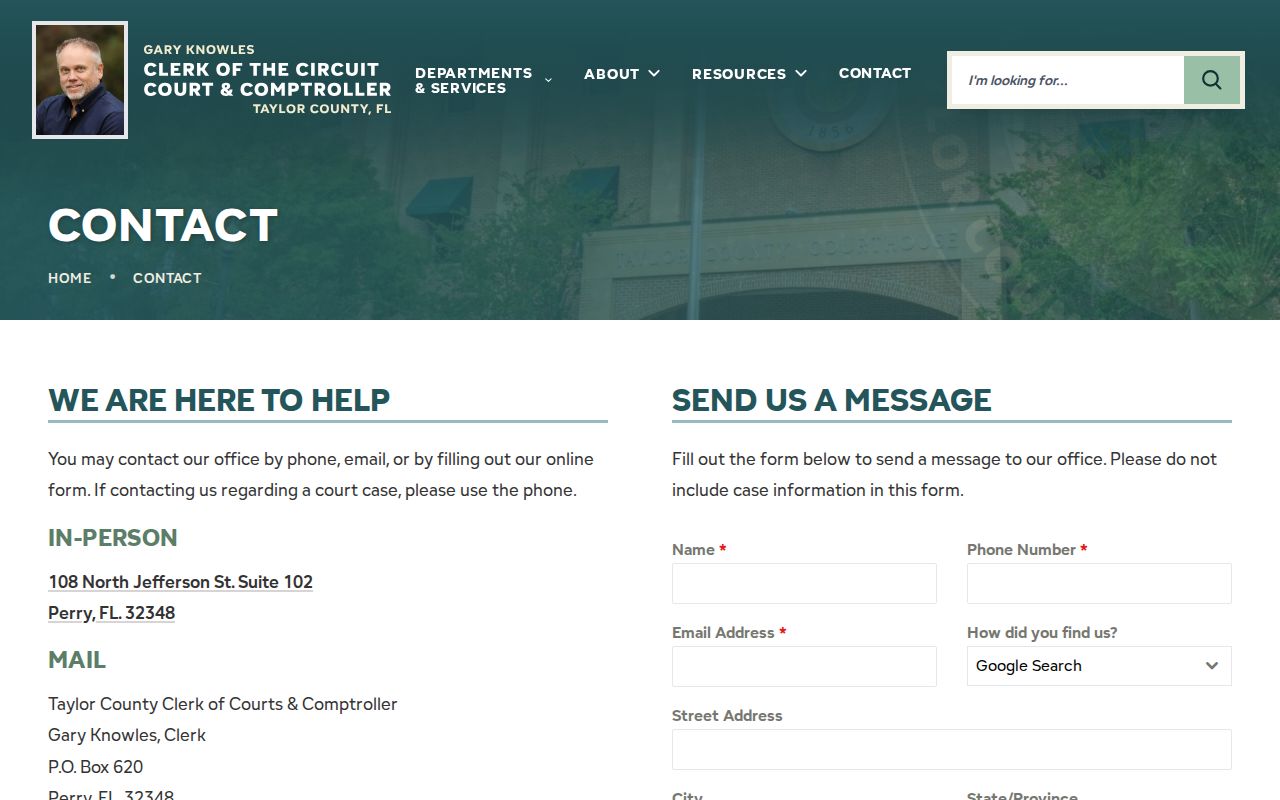
A direct request is especially useful for older files, certified copies, and records not available through a public screen.
Taylor County Clerk
108 N. Jefferson Street
Perry, FL 32347
850-838-3506
Courthouse hours are generally 8:00 a.m. to 5:00 p.m.; verify the criminal counter before travel.
What the Case File Shows
A Taylor County court file is organized around the court case, not the booking event. It can show what charge the State Attorney actually filed, which may differ from the arresting officer's initial charge. The docket then records notices, hearings, pleas, motions, court orders, trial events, judgment, sentence, and later supervision or violation filings. For a full judicial outcome, request the disposition and judgment rather than relying on the first charge line.
| Case Number & Court | Filing year, sequence, division, judge, and open or closed status |
|---|---|
| Charging Document | Information, indictment, complaint, counts, statutes, and amendments |
| Docket Entries | Chronological register of pleadings, notices, motions, and orders |
| Hearing Dates | Arraignment, pretrial events, plea, trial, sentencing, and later reviews |
| Disposition & Judgment | Conviction, acquittal, dismissal, nolle prosequi, or other count-level outcome |
| Sentence & Conditions | Custody, probation, community control, fines, costs, and restitution |
Financial entries may list assessments, payment status, and restitution. Confidential identifiers, protected victim or minor information, sealed documents, and protected addresses will not appear in the public copy.
Taylor County Case Codes Decoded
A few Florida terms make the Taylor County docket much easier to read. An information is the formal charge filed by the State Attorney. Nolle prosequi means the prosecutor formally chose not to continue a charge at that time. A withhold of adjudication is a resolution without formal adjudication of guilt, subject to legal limits. It is not the same as a dismissal.
- Disposition
- The outcome of a count or case, such as conviction, dismissal, or acquittal.
- Capias
- A court order commanding arrest, sometimes entered after filing or a failure to appear.
- Nolo contendere
- A no-contest plea in which the accused does not contest the charge.
- Community control
- Florida's intensive form of community supervision.
- Certified disposition
- A clerk-certified copy of the official outcome, often used to correct or prove the result.
Read each term beside the count and later docket entries. One case can have several counts with different outcomes.
Stages of a Criminal Case
A Taylor County matter may begin with an arrest or notice to appear. A person held after arrest generally receives prompt first-appearance review under Florida procedure. Law enforcement then sends its case to the State Attorney, who may decline charges, amend the arrest charge, file an information, or present a matter for indictment. Arraignment follows the filed accusation. Discovery, motions, and hearings lead toward a plea or trial.
Case flow: Charges Filed › Arraignment › Pretrial › Plea or Trial › Disposition › Sentencing
Judgment and sentence do not always end the record. An appeal, probation filing, violation affidavit, capias, or postconviction motion can add later entries. The Taylor County criminal case file remains the best source for that procedural trail.
Taylor County Filed Charges Differ
A booking charge is the allegation recorded at jail intake. It is not necessarily the charge that appears in a Taylor County trial file. The State Attorney reviews the agency submission and may add, reduce, change, or decline counts. A grand jury may also return an indictment in a qualifying matter. This is why the arrest page and court docket can tell different stories without either being a duplicate.
The Third Judicial Circuit Public Defender represents eligible court-appointed clients, while the State Attorney prosecutes. Neither office replaces the clerk as the public docket custodian.
The defense office source helps identify representation channels, but court copies still come from the Taylor Clerk.
Taylor County Case Appeals Use ACIS
Florida's Appellate Case Information System, or ACIS, serves appellate cases. It can show an appellate case number, classification, originating Taylor County court, lower-tribunal number, parties, counsel, status, argument information, and appellate docket entries. It does not prove that the complete Taylor trial file is online. Use its lower-tribunal number to return to the Taylor Clerk for the information, evidence-related filings, judgment, or sentence.
A Taylor-origin appellate example may display a number such as 2020-CF-136 and identify the Circuit Court for the Third Judicial Circuit. That vocabulary is useful for locating the local case. Still, ACIS is an appeal index and document channel. It should not be treated as Florida's missing statewide trial-court search.
Taylor County Court Copy Choices
Ask what the record will be used to prove before ordering. A plain copy can be enough for reading a pleading or tracing the docket. A certified copy carries the clerk's formal certification and may be required when correcting a missing FDLE disposition, pursuing sealing or expunction, or presenting the result to another official office. Certification costs more, so name the exact judgment, sentence, or disposition needed.
The clerk publishes a current fee-schedule gateway. Research did not establish a safe fixed total for every copy request.
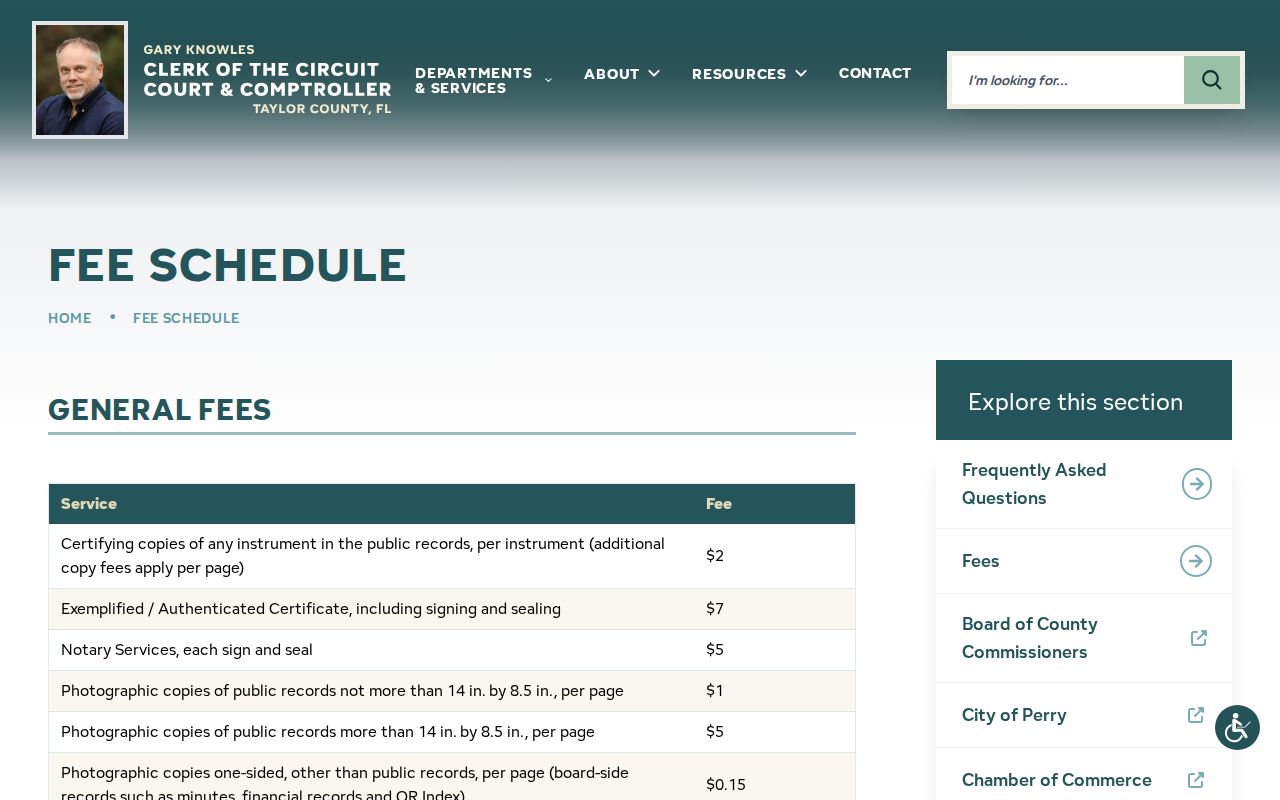
Check the live schedule or request an estimate before paying, especially for a large file or several certified documents.
Access & Restrictions
Florida Constitution article I, section 24 protects access to public records, while Florida court access Rule 2.420 governs judicial records and confidentiality. Public access does not override every exemption. Many juvenile matters, sealed or expunged records, protected victim information, confidential identifiers, protected addresses, and some active investigative material may be withheld or redacted.
A missing online file may therefore reflect restricted access rather than a technical problem. Ask the Taylor Clerk whether the case exists and whether a rule or order limits disclosure. If only part is exempt, request the nonconfidential remainder and the legal basis for each redaction. Court records and law-enforcement reports also remain separate: the clerk supplies the judicial file, while TCSO or Perry Police supplies its own incident narrative.