
Arrest History in Taylor County
The Taylor County Sheriff's Office makes arrests across unincorporated areas, serves countywide warrants, and operates local booking. Perry Police handles city incidents. Florida Highway Patrol and Florida Fish and Wildlife Conservation Commission officers may also make arrests that enter Taylor County Jail. FDLE and federal agencies have authority in their own cases. The agency named on a booking entry is therefore the place to seek the incident narrative.
Taylor County arrest history is not one permanent roster. The jail entry records custody, the arresting agency holds its report, the clerk holds any filed case, and FDLE assembles qualifying fingerprint events statewide. Older or released bookings may disappear from the live view. The official page for Sheriff Wayne Padgett's office identifies the county's law-enforcement administration.
That office context helps distinguish TCSO administration from the jail, clerk, and prosecutor, which keep different parts of an arrest trail.
Taylor County Roster Choices
TCSO labels its booking publication “Recent Arrests” and links the live jail interface. Recent arrests and current inmates overlap, but they answer different questions. A person may leave the current roster after release or transfer even though the booking still occurred. A spelling mismatch or data delay can also hide an entry.
The official Taylor inmate search is the first source for a fresh local booking.
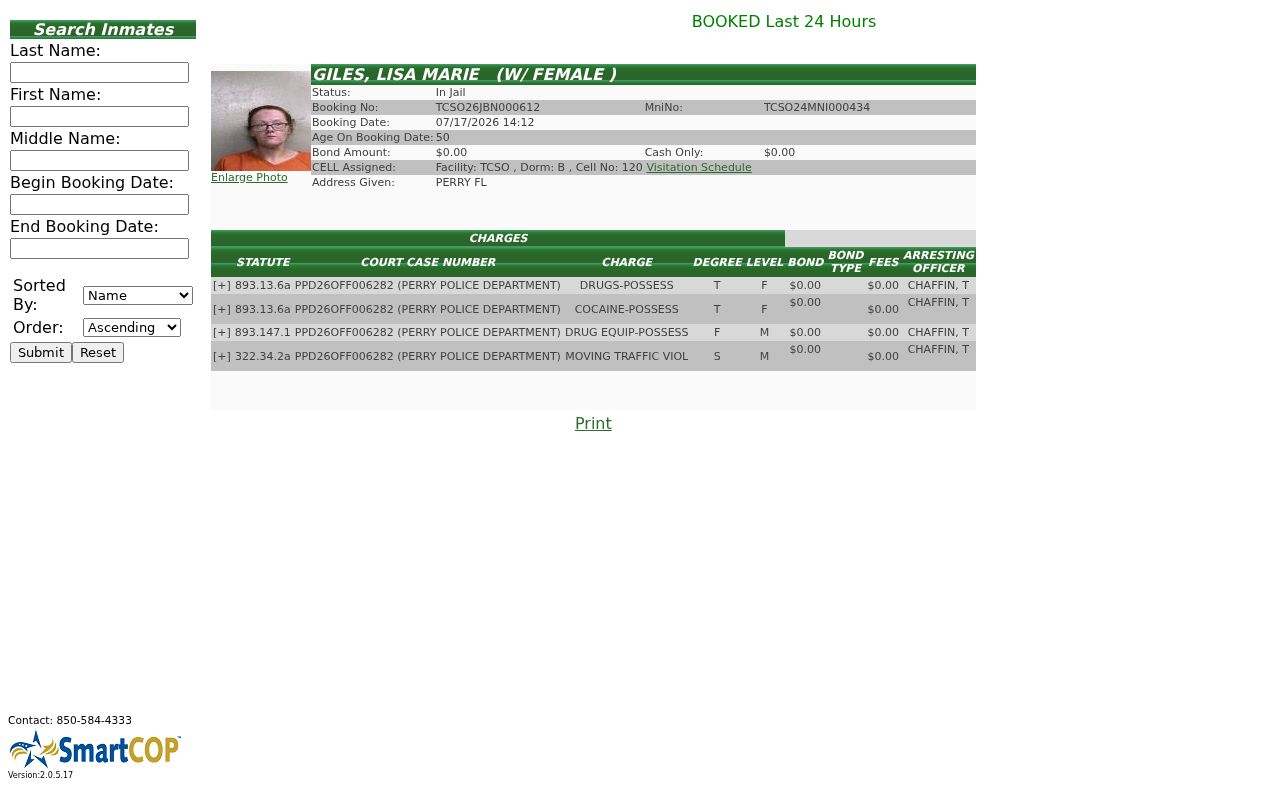
Save the booking identifier and access date because custody changes quickly. A roster disappearance is not a dismissal and proves nothing about the later court result.
How to Look Up Taylor County Arrests
Start with the source closest to the event, then move outward. A booking number, agency case number, incident date, or court case number is a stronger key than a name alone. The sequence covers every documented Taylor County access channel.
- Open the TCSO recent-arrest or inmate search. Try spelling variants and save the booking number, date, agency, charges, and status.
- Call TCSO at 850-584-4225 if the site is down, the event is new, or release or transfer is possible. Ask which agency booked the person.
- Request the booking sheet from TCSO and the arrest narrative from the arresting agency. Perry Police reports remain with PPD.
- Check the Taylor Clerk criminal division after filing. Specify Circuit Criminal for felonies or County Criminal for misdemeanors.
- Use FDLE Criminal History Services for statewide history, and the TCSO public-record route for nonexempt records missing online.
TCSO Administration and Records
108 N. Jefferson Street, Suite 103
Perry, FL 32347
850-584-4225
Confirm counter hours before visiting.
The TCSO public-records page is the formal fallback for a booking sheet, arrest report, dispatch record, warrant return, or other nonexempt material.
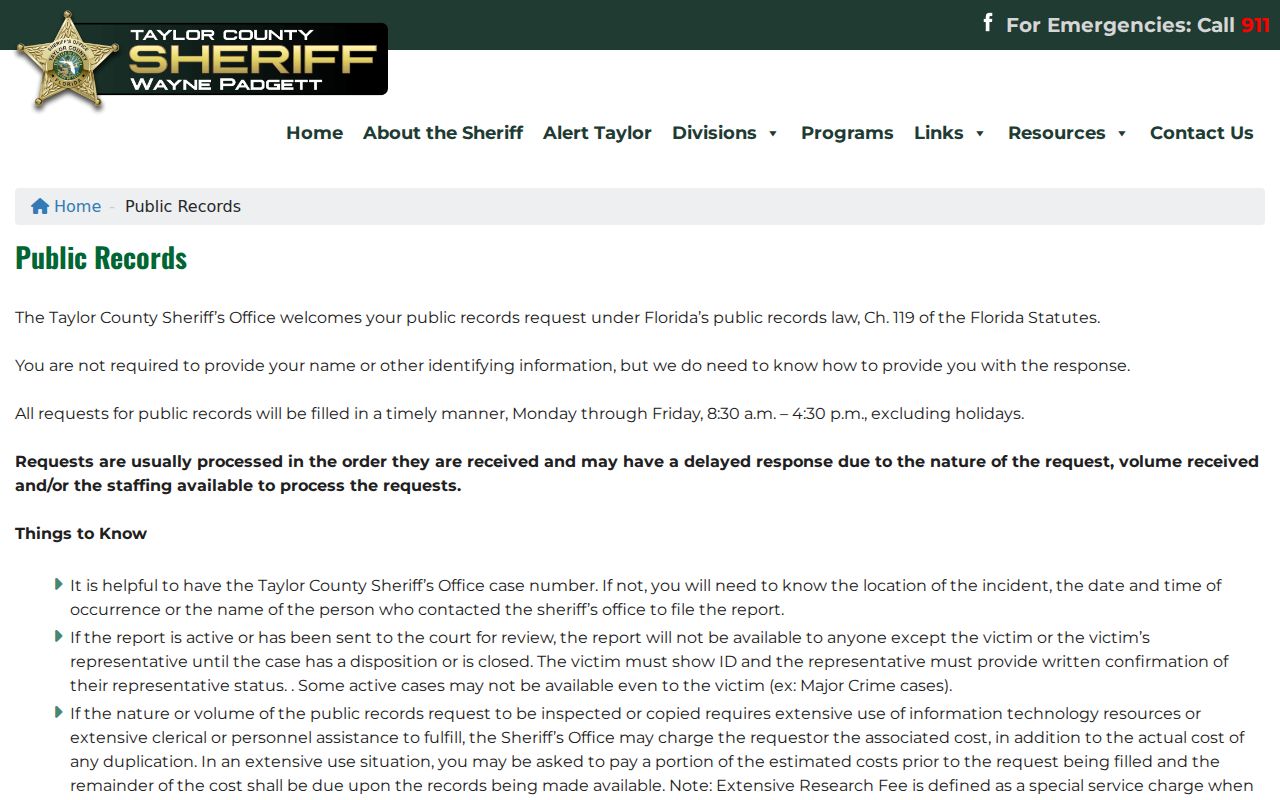
Give a narrow date range, location, record type, incident number if known, and preferred electronic format. Florida law does not require a special form or a stated purpose for an ordinary public request.
A focused request is easier to process than a demand for every record tied to a name. State the event date, approximate time, place, agency, and exact item wanted. Ask for a booking sheet when custody fields are the goal. Ask for an arrest affidavit or incident report when the officer's account is needed. Dispatch logs, 911 audio, body-camera footage, photographs, and warrant returns should be named separately. Electronic delivery can reduce paper costs, and a requester may ask for an estimate before extensive work begins.
Florida Public Records Law permits inspection and copying of nonexempt records at reasonable times. It also allows lawful copy charges and a special service charge when a request takes extensive staff or technical resources. Active investigative information, victim details, juvenile data, medical information, security details, and protected identifiers may be withheld or edited. If part of a record is exempt, ask for the nonexempt remainder and the statutory reason for each redaction. Taylor County research did not confirm a fixed response deadline or a local flat fee, so requesters should not promise themselves a set turnaround or cost.
Taylor County Custody Split
A Perry arrest can create a city police report and a Taylor County booking sheet. PPD's narrative may state probable cause, location, witnesses, evidence, and officer actions. TCSO's booking record tracks intake, received charges, bond, holds, and release. Ask each custodian for its own record. The same split applies when FHP or FWC makes the arrest.
The official Taylor County Jail information page routes readers to county custody resources.
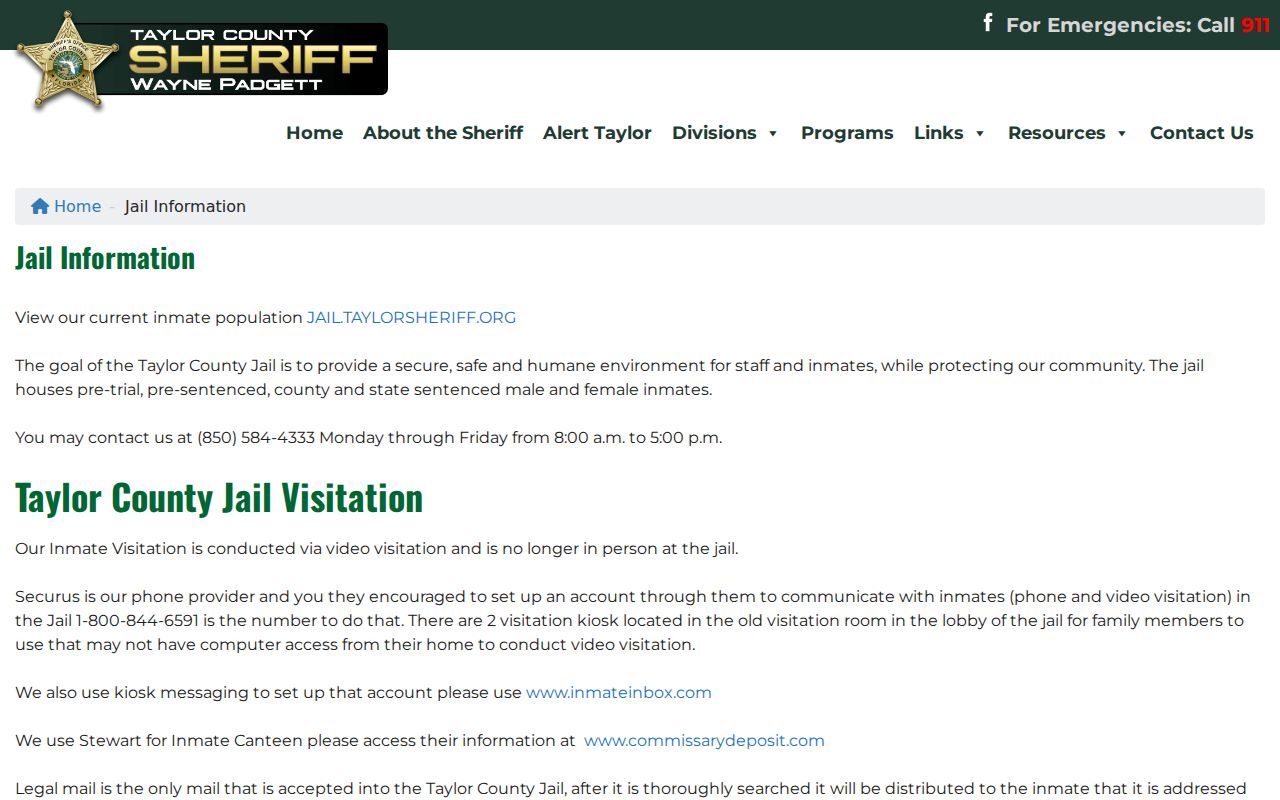
Call before visiting because the reviewed official text did not confirm the current lobby address, visitation vendor, deposit vendor, or detailed entry rules.
What a Taylor County Arrest Record Shows
A booking entry is a compact custody record. The full arrest report may add the alleged location, probable-cause narrative, officers, evidence, witnesses, property, vehicle information, and warrant basis. Protected victim data, juvenile information, medical details, personal identifiers, and active investigative material may be withheld or redacted.
| Booking Number | The jail identifier for the intake event and the best key for matching similar names. |
|---|---|
| Booking Date & Time | When intake was entered, which may differ from the incident time. |
| Arresting Agency | TCSO, PPD, FHP, FWC, FDLE, or another agency that holds the report. |
| Charges | Allegations received at booking, not necessarily charges later filed. |
| Bond | Amount and type, or a hold or no-bond status when public. |
| Mugshot Policy | A photograph may be public absent an exemption, but every image is not guaranteed to be posted or released. |
| Release Status | Current custody, release, court order, sentence completion, or transfer when displayed. |
Four Taylor County Arrest Records
One arrest can create four linked documents. The arresting agency writes the report. Taylor County Jail creates the booking sheet. The clerk opens a court file if the State Attorney files charges. FDLE may associate the fingerprint arrest cycle and disposition in statewide history.
Record flow: Agency report → Taylor County booking → Clerk case file → FDLE arrest cycle and disposition.
The State Attorney's Perry office makes charging decisions but does not maintain the jail roster or clerk docket.
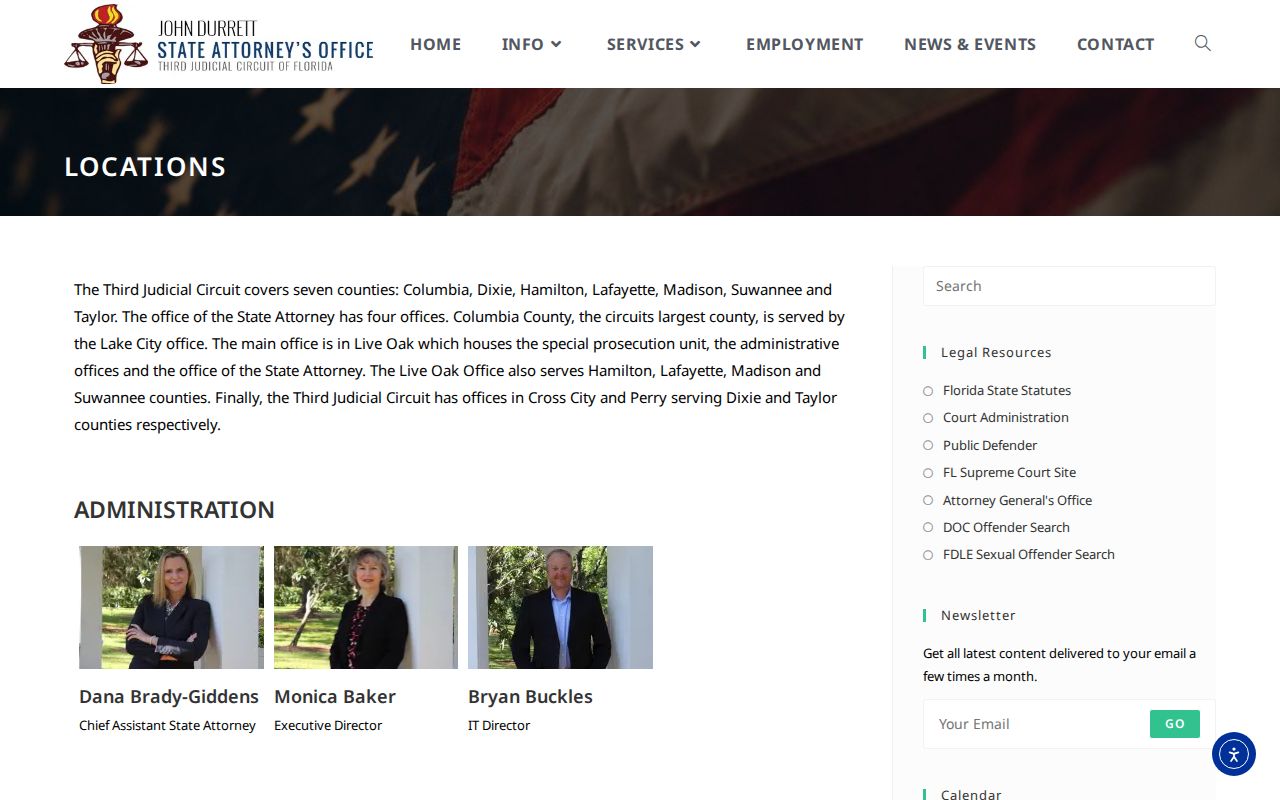
The prosecutor may narrow, change, or decline booking allegations, making the later court file essential to an outcome check.
Taylor County Recent Arrests
The TCSO homepage links Recent Arrests and Inmate Search to the official jail domain. It is useful for current and recent custody, not as a permanent arrest archive. Search variants and note the booking number, date, agency, charge, bond, and status. No fixed update interval was confirmed, so a phone call may be needed for a same-day event.
Release, transfer, data delay, or alternate spelling can explain an absence. Use Florida VINELink for custody notifications and FDC Offender Search after state-prison transfer.
Note: Taylor County Jail states that only legal mail is accepted, so ordinary personal mail should not be sent.
Taylor Arrests and FDLE Lag
FDLE is not the fastest source for a same-day Taylor County booking. Fingerprints and arrest data must be transmitted and matched. Later charges and the court disposition must also be linked. Reporting delay, identifier mismatch, legacy data, or a nonfingerprintable event can create gaps.
The Florida CCHInet search is a paid name-based Florida search, not an FBI nationwide check. Positive identification requires fingerprints. A person reviewing their own history can use FDLE's fingerprint review through an approved LiveScan provider. A missing disposition may require a certified Taylor Clerk copy and FDLE challenge.
A jail roster, clerk case file, and FDLE history answer different questions. None substitutes completely for the others.
Taylor County Warrant Arrests
A warrant arrest has an issuing-court record, execution or return, booking entry, and later docket action. A warrantless arrest instead relies on statutory authority and probable cause in an affidavit or report, followed by prompt first-appearance review.
A capias often directs arrest after charges are filed or a person fails to comply with a court requirement. It differs from a search warrant, which authorizes a search and may remain sealed during an active investigation. A public warrant listing can show a name, case or warrant number, charge, issuing court, date, and bond status, but the exact live Taylor result fields were not confirmed.
TCSO provides warrant information and links an official open-warrant search. Use it as a lead, then confirm directly because public status may lag.
The TCSO warrant and civil-process page explains the county channel.
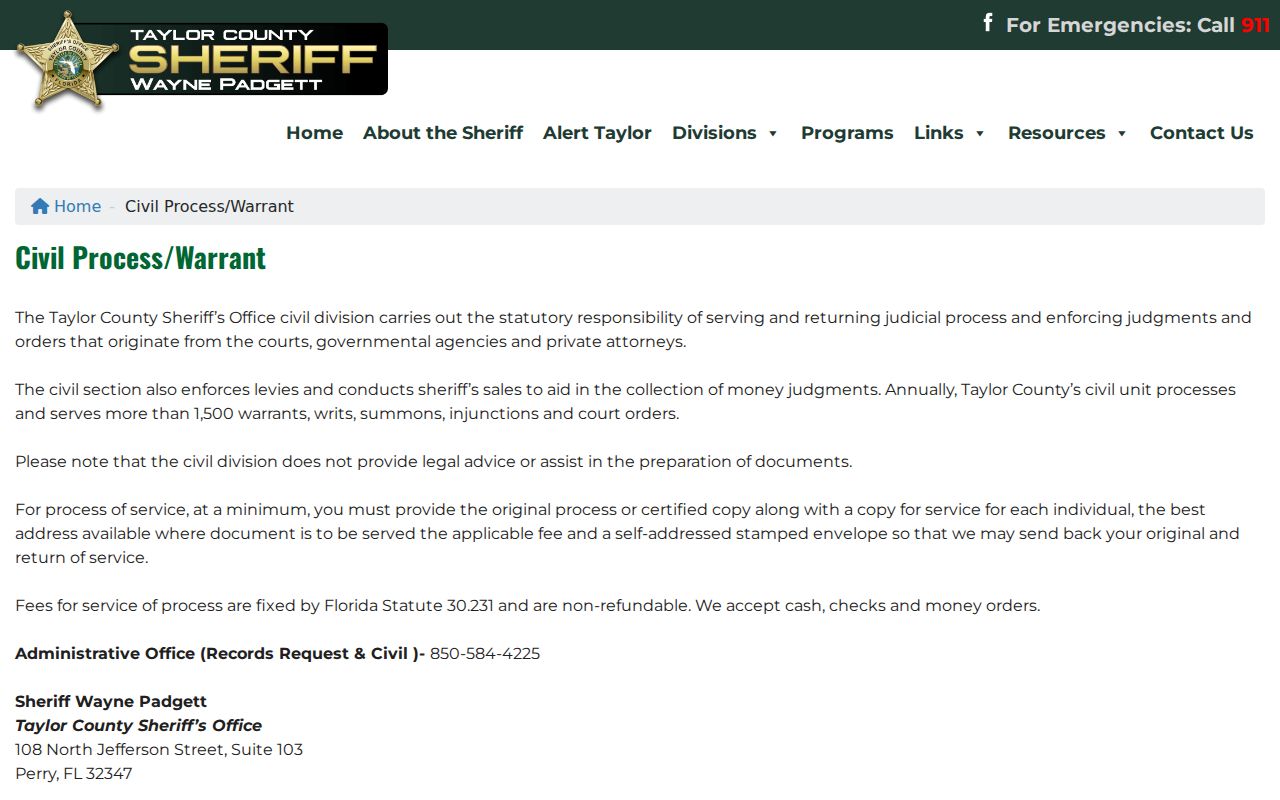
For a personal warrant concern, obtain the case number and bond status, consult counsel, and follow official surrender or hearing instructions.
Taylor County Arrests vs Convictions
An arrest record shows that an agency took a person into custody on stated allegations. It does not prove that the prosecutor filed the same charge or that a court found guilt. A conviction follows a guilty plea, verdict, or adjudication in the clerk's judgment. Both records must be checked to avoid mistaking a booking claim for the final case result.
A dismissal or decision not to file does not automatically erase the agency and repository trail. Florida sealing and expunction are separate court processes with different effects and eligibility rules. A person examining their own Taylor County history should obtain the final clerk disposition before drawing a conclusion or seeking relief. FDLE generally requires a certificate of eligibility before an ordinary petition, and that certificate does not guarantee that a judge will grant the request. Juvenile and already protected matters follow different access rules.
| Arrest Record | Conviction Record |
|---|---|
| Created by the arresting agency and jail | Created by the Circuit or County Court |
| Shows a booking occurred on allegations | Shows a court finding and disposition |
| Lives in agency and booking systems | Lives with the clerk and may reach FDLE |
| May lead to release, no filing, dismissal, or prosecution | May lead to sentence, appeal, or lawful record relief |
Note: An arrest is not proof of guilt; a booking may end without charges, by dismissal, or with an acquittal.